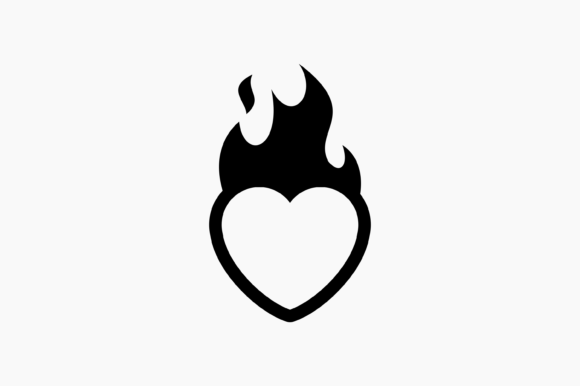
Flaming Heart: A Designer’s Real-World Embroidery Review
As a designer who’s stitched hundreds of custom pieces—from boutique aprons to Etsy baby onesies—I opened Flaming Heart expecting boldness. What I found wasn’t just a graphic; it was a mood with intention. The shape is clean but charged—symmetrical enough for balanced hooping, yet expressive enough to carry emotional weight. It reads instantly as love, passion, or fierce individuality—not kitsch, not cliché. That matters when you’re stitching something meant to live on a sweatshirt worn daily, or a kitchen towel gifted at a wedding shower.
First Impressions That Translate to Stitched Reality
The silhouette holds up beautifully at glance and at 10 inches away—critical for apparel and tote bag designs. There’s no visual clutter: no tiny filigree, no overlapping flames that risk stitching confusion, no ambiguous negative space. That simplicity is strategic. In machine embroidery design, fewer small transitions mean fewer thread breaks, cleaner satin stitch edges, and better fill stitch consistency—even on textured fabrics like terry cloth or looped cotton.
I tested Flaming Heart as the centerpiece for a custom embroidered tote bag destined for a local florist’s gift set. On natural canvas, with medium-weight cutaway stabilizer and matte black thread, it landed with quiet confidence—not flashy, not shy. Customers responded before even reading the tagline: “It *feels* handmade, but polished.” That’s the sweet spot for craft business owners and Etsy sellers: authenticity with intention.
Where It Shines—and Where It Needs Thoughtful Handling
Flaming Heart works exceptionally well for:
- Sweatshirt embroidery — its compact height (no tall verticals) avoids distortion across shoulder seams or curved hems;
- Embroidered patches — clean outer edge allows crisp heat-seal or sew-on application without fraying concerns;
- Baby embroidery — soft curves and absence of sharp interior corners make it gentle on delicate knit onesies and burp cloths;
- Holiday embroidery — pairs effortlessly with subtle metallic thread or tone-on-tone stitching for Valentine’s, Galentine’s, or even inclusive anniversary gifts;
- Commercial embroidery projects — scalable without losing integrity, so it serves both single-name personalization and boutique branding runs.
But real-world use means real constraints—and here’s where attention pays off:
- Small hoop sizes: While it fits comfortably in a 4×4 hoop, pushing into 3×3 requires verifying that flame tips don’t clip or compress unnaturally—always test on scrap first;
- Stretchy fabric: Not ideal for unlined jersey tees unless paired with tear-away + topping; the smooth outer curve can shift during stitching without proper stabilization;
- Dark fabric: Works strongly in high-contrast thread (e.g., white on navy), but avoid light pastel fills—they’ll mute on charcoal or black without dense underlay;
- Curved surfaces like caps: Its symmetry helps, but placement matters—center front works best; avoid crowns or deep curves where flame taper may distort;
- Frequent-wash items: As a fill-stitch–dominant design, confirm stitch density isn’t overly aggressive—tight fills can stiffen lightweight tea towels or baby blankets over time.
What It Adds to Your Finished Product—Beyond the Thread
A design isn’t just lines—it’s perception. Flaming Heart elevates handmade product value because it looks *designed*, not downloaded. That distinction builds customer trust: buyers sense care in selection, not just convenience. For personalized gifts or small shop merchandise, that nuance translates directly to perceived professionalism and willingness to pay premium pricing.
It also supports brand consistency. Whether you’re embroidering matching aprons for a café launch or creating a cohesive holiday collection for your Etsy shop, Flaming Heart holds its own alongside typography or supporting motifs—never overwhelming, never fading into background noise. And because it’s emotionally resonant without being gendered or age-specific, it broadens appeal across audiences: teens buying their first custom cap, new parents gifting nursery decor, or couples ordering wedding keepsakes.
Practical Designer Notes Before You Hoop It
This isn’t just about opening a file—it’s about honoring your process and your clients’ expectations. Here’s what I do every time I evaluate a digital embroidery file like Flaming Heart:
- Test on scrap fabric that matches your final project’s weight and texture—especially important for baby embroidery or custom apparel;
- Check thread color contrast in both natural and artificial light—some reds flare under LED, others dull on camera;
- Review stitch density visually in your embroidery software—if flame tips look pixelated or overly sparse, adjust underlay or reduce density slightly;
- Confirm hoop size compatibility with your machine and intended garment location—don’t assume 4×4 fits everywhere;
- Inspect small details at 200% zoom: are inner flame gaps wide enough to prevent thread nesting? Is the heart base stable enough for satin stitch anchoring?
- Test in black-and-white mockups—if it reads clearly without color, it’ll translate reliably across fabric types and lighting conditions;
- Compare light vs. dark fabric backgrounds using printable mockups—this reveals how much detail survives on low-contrast substrates;
- Use proper stabilizer—cutaway for knits, tear-away for stable wovens, and always consider topping for napped fabrics like fleece;
- Verify licensing terms before selling finished items or bundling Flaming Heart into digital product previews—commercial use is implied, but always double-check scope;
- Ask yourself: does this support my voice? If your brand leans minimalist, rustic, or modern—yes. If you specialize in ornate scrollwork or hyper-detailed florals, it may sit outside your core aesthetic.
Ultimately, Flaming Heart earns its place not because it’s trendy, but because it’s reliable. It stitches cleanly, reads clearly, and carries warmth without sentimentality. Whether you’re a solo maker prepping for craft fair season or a small shop owner building repeatable design assets, it’s the kind of embroidery file that quietly strengthens your output—stitch by intentional stitch.